Can Soult Help You Conceal Undisclosed Assets?
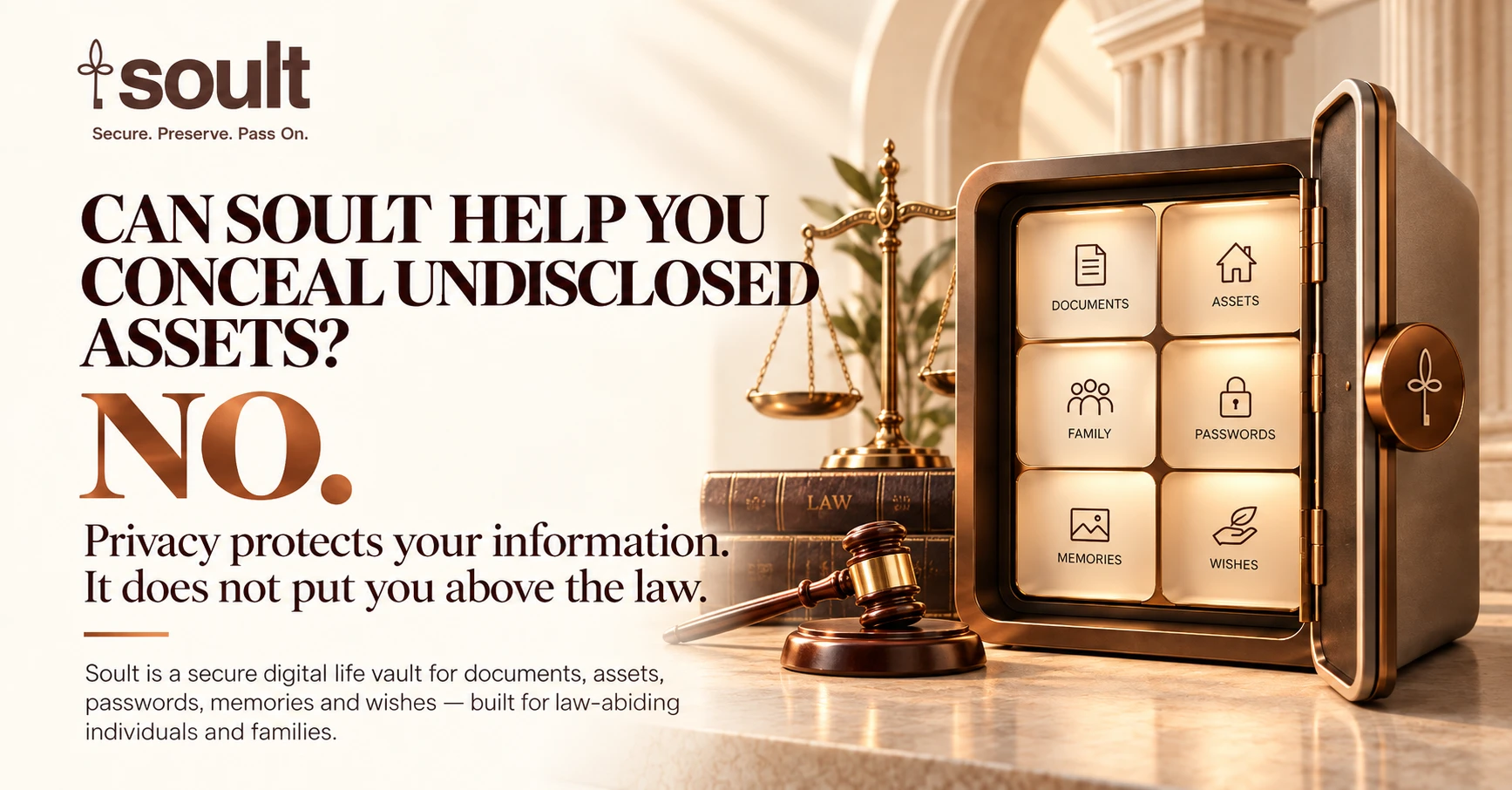
No — and that's by design. Privacy protects your information; it does not put you above the law. Why Soult is a vault for continuity, not concealment.
I was asked this question after presenting Soult in Mumbai yesterday.
Not once, but in slightly different forms.
"If I have an undisclosed asset, can I put it in Soult?"
"Because Soult is encrypted, can nobody find it?"
"What if the government asks for the information?"
I found the questions interesting, but also disturbing.
So rather than giving a diplomatic answer, let me answer them publicly.
No. Soult is not being built to help anyone conceal illegal or undisclosed assets.
And encryption does not change that.
Soult is the World's First Secure Digital Life Vault.
We built it so people can securely document their lives: assets, documents, passwords, memories, wishes, relationships and the information their families may eventually need.
We did not build it as a digital hiding place.
There is a difference.
Privacy and concealment are not the same thing
I absolutely believe in privacy.
In fact, Soult could not exist without it.
If I entrust a platform with my property documents, insurance policies, passwords, family memories, personal wishes or medical information, I should expect that information to be protected.
I should expect strong encryption.
I should expect controls around who can access it.
I should expect employees not to casually browse through it.
I should expect different kinds of information to receive different levels of protection.
That is privacy.
But saying:
"I have an asset that I am legally required to disclose, but I deliberately want to hide it from the authorities. Will your encryption help me?"
is an entirely different question.
That is not privacy.
That is asking technology to facilitate concealment.
Soult will not position itself that way.
"But surely I can type anything into Soult?"
Of course.
Soult is not an income-tax officer, auditor, registrar or investigating agency.
When you create an asset record, Soult does not independently investigate whether you actually own it, whether its value is accurate, whether it appears in your tax return or whether every declaration relating to it has been made.
That responsibility remains with you.
We provide a platform for documenting your life.
We do not certify every statement a user enters into it.
But please don't confuse those two things.
There is a huge difference between:
"Soult does not independently verify every piece of information I enter."
and:
"Soult will help me conceal something that I am legally required to disclose."
The first is how a personal information platform works.
The second is not a business we are interested in building.
Encryption is not immunity
This is another misconception worth addressing.
People sometimes hear words such as encryption, zero knowledge, client-side encryption, or secure vault, and translate them into:
"Great. Nobody can ever touch me."
That is not what security means.
Security means protecting information against unauthorised access.
It means designing systems so that information is not casually exposed.
It means minimising unnecessary access.
It means ensuring that one compromised component does not automatically expose somebody's entire life.
It does not mean promising users that technology places them above the law.
Soult will comply with the laws applicable to it.
That statement should not frighten a law-abiding user.
In fact, I would argue that it should increase trust.
There is also a legitimate version of this question
Someone asking:
"What happens to my information if a government agency serves Soult with a valid legal order?"
is asking a perfectly reasonable question.
I would ask it too before putting sensitive information into any digital vault.
That person wants to understand our privacy architecture.
What can Soult access?
What can Soult not access?
Which information is protected on the device?
How are encryption keys managed?
What does controlled handover mean?
What information could technically be produced if legally required?
Those are serious security questions, and we should answer them transparently.
But:
"Can you design the product so I can hide undisclosed wealth?"
is not the same question.
And I don't think founders should pretend that it is.
Soult was created for exactly the opposite purpose
The irony is that Soult exists because too much information disappears.
Families don't know what assets exist.
They don't know where documents are.
They don't know which policies were purchased.
They don't know the passwords.
They don't know the nominee arrangements.
They don't know the wishes behind certain possessions.
Sometimes they don't even know which financial institutions to approach.
Soult exists to create continuity, not concealment.
We saw two gaps when we started building it.
The first was human value.
A system may know that my wedding ring contains ten grams of gold.
It cannot know what that ring means to me.
Who gave it to me.
What memory it carries.
And who I eventually want to receive it.
The second gap was continuity.
Our lives are fragmented across financial institutions, phones, emails, cupboards, cloud drives, physical files and our own memories.
Soult brings those pieces together so that the person who owns that life can document it properly and decide how the appropriate parts should eventually reach the right people.
That is why our promise is:
Secure. Preserve. Pass On.
Notice the third word.
Pass On.
Not hide.
Not conceal.
Not disappear.
In fact, this question helped me
Initially, I was irritated when people asked me whether Soult could help them conceal undisclosed assets.
Then I realised something.
It gives us an opportunity to be very clear about what kind of company we want Soult to become.
We want to build technology that protects people.
We want to build serious privacy architecture.
We want information compartmentalised.
We want strong encryption.
We want users to retain meaningful control over their lives.
We want controlled handover rather than shared passwords and uncontrolled access.
And we are building CHAKRA around the difficult problem of combining strong security with controlled recoverability.
But none of those things requires us to become a hiding place for unlawful activity.
Quite the opposite.
Trust requires boundaries.
And this is one of ours.
So if somebody asks me again:
"Can I use Soult to conceal my undisclosed assets?"
My answer is simple.
No.
Use Soult to document your life.
Use it to protect your private information.
Use it so your family knows what exists.
Use it to preserve the meaning behind what you own.
Use it to make sure important information reaches the people you choose when it matters.
But if the product you are looking for is a digital bunker for illegal wealth, Soult is not that product.
And I am perfectly comfortable losing that customer.
Soult — the World's First Secure Digital Life Vault.
Secure. Preserve. Pass On.
Ready to secure your family's future?
Start your free Life Vault today. No credit card required.
Start Free