An Encrypted Box Is Not a Digital Life Vault
Encryption protects your data. Recoverability and secure handover protect its future. Five common mistakes, and the seven questions to ask before choosing a Digital Life Vault.
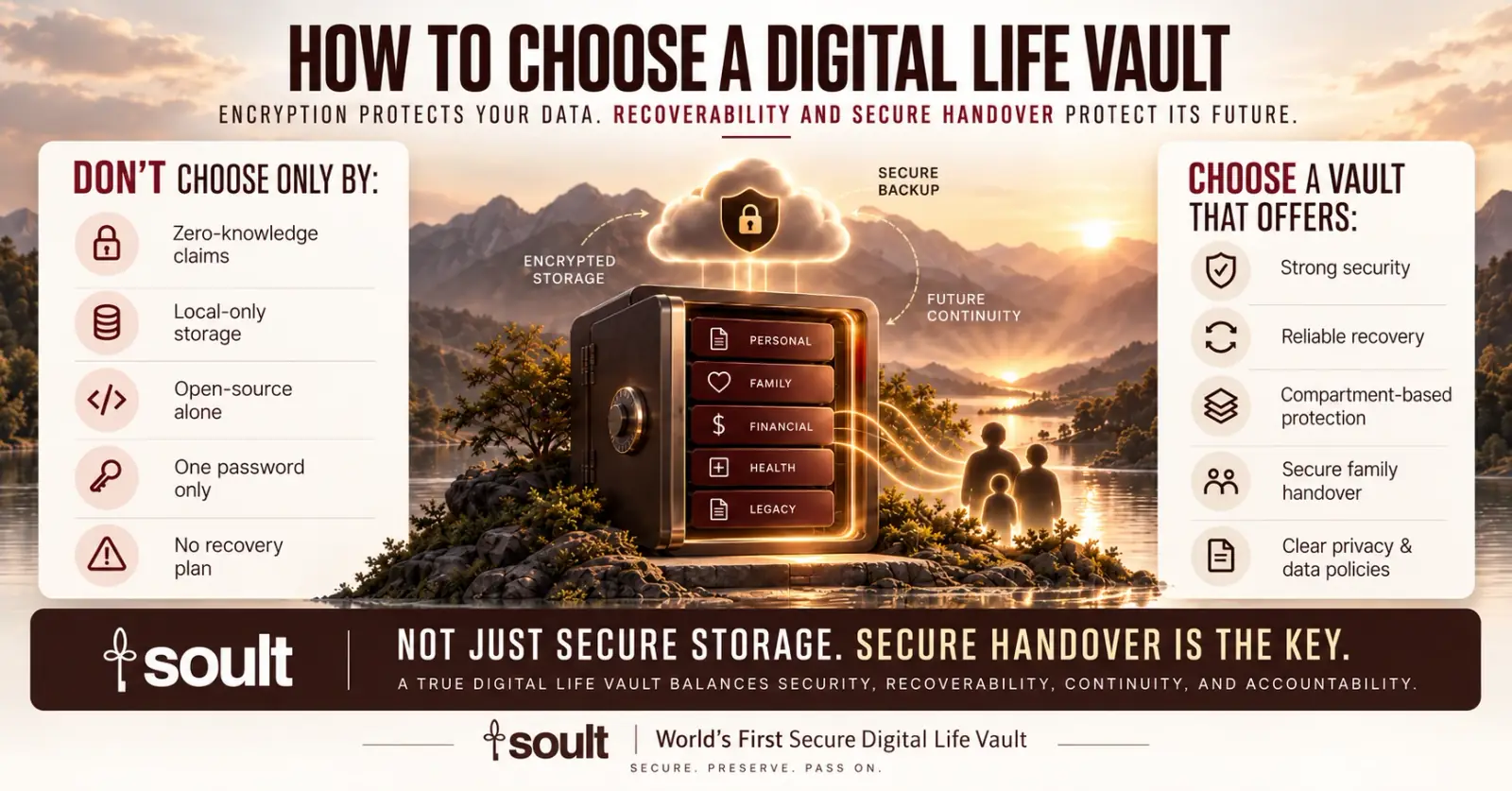
Every few weeks, another product appears promising to secure your digital life.
Some advertise zero-knowledge encryption. Others highlight open-source technology, military-grade security, local storage, or the assurance that even the provider cannot access your information.
These are all interesting capabilities. Some are genuinely valuable.
But here is my concern.
We are confusing the technology used to protect information with the purpose of preserving it.
A password manager is not automatically a Digital Life Vault. An encrypted database is not automatically a Digital Life Vault. And calling something a legacy vault does not mean it can actually preserve and pass on a person's legacy.
The distinction becomes critical when life takes an unexpected turn.
The first mistake: Assuming encryption means preservation
Imagine spending years recording important information about your life. Financial records, property details, insurance policies, documents, passwords, family photographs, personal memories, wishes, and instructions for your loved ones.
Everything is carefully organized and encrypted.
Then your phone is lost. Or you forget your master password. Or something happens to you unexpectedly.
Can you recover the information? Can your family access what they need? Can anyone explain what should happen next?
A vault can be technically secure and still fail the very people it was meant to protect. And that is the fundamental issue consumers need to understand.
Different vault architectures will always exist. Understand their trade-offs.
Let me be clear: I am not arguing against zero-knowledge encryption, open-source software, local storage, or password managers. These technologies have legitimate uses. They will continue to exist, evolve, and improve.
But each architecture makes different trade-offs.
1. Local-first encrypted vaults
These typically store encrypted information directly on your phone or computer. The advantage is greater control over where your information resides and potentially less dependence on a service provider.
The risk arises when the device contains the only usable copy. If it is lost or damaged, and no independent backup exists, the information may disappear permanently. Even a recovery phrase cannot recreate a vault file that no longer exists.
Local storage is not inherently unsafe. But a local-only vault without a tested backup strategy is a risky place to preserve a lifetime of information.
2. Zero-knowledge encrypted vaults
These are designed so the provider cannot independently decrypt the protected contents. That is a meaningful privacy benefit.
However, this shifts considerable responsibility for key management to the user. If the only usable decryption credential is lost, the information may remain permanently inaccessible.
Well-designed zero-knowledge systems can provide encrypted cloud backups, trusted-device recovery, recovery keys, or prearranged emergency access. So the issue is not zero-knowledge encryption itself. The issue is whether recovery and continuity were actually designed into the product, rather than left entirely to the customer.
3. Open-source vaults
Open source is often presented as an automatic guarantee of security. It isn't.
Making source code available allows independent inspection. That is valuable. But it does not automatically prove that the deployed application is secure, its servers are configured properly, its backups are recoverable, or its emergency-access process is dependable.
Open source is a transparency advantage, not a substitute for security testing, accountability, or continuity planning.
4. Managed cloud vaults
Cloud-based services can make information available across devices, support backups, and reduce dependence on a particular phone.
But cloud storage comes with responsibilities. Who can access the information? Who manages the encryption keys? Where is the data processed? What happens during an outage, breach, or business closure?
Cloud storage alone is not the answer either.
Every architecture solves certain problems and introduces others. The right choice depends on what you are protecting, why you are preserving it, and who may eventually need it.
The second mistake: Treating every piece of life information equally
Think about everything that makes up a person's life. A warranty document. A property deed. An insurance policy. A bank account. A medical preference. A family tradition. A personal secret. A message intended only for a spouse or child.
Should all these require the same protection, the same recovery method, and the same access permissions? Of course not.
Some information should be readily available when needed. Some needs stronger protection. Some must remain strictly confidential. And some should be passed on only under specific conditions.
A true Digital Life Vault needs to recognize different levels of sensitivity, different access requirements, and different responsibilities. That is why compartment-based protection matters.
Not everything belongs behind one master password, with the same consequences if that password is lost or shared.
The third mistake: Assuming storing information is the same as preserving a life
This, to me, is the biggest misunderstanding.
A Digital Life Vault should not become useful only when someone dies. It should help people throughout their lives.
Imagine having important documents, responsibilities, memories, wishes, and personal records organized in ways that make everyday life easier. You know what you own, where your information is, what needs attention, and what matters to you.
But a person's life is much more than a collection of assets.
What about the lessons learned over decades? The stories behind family heirlooms? The traditions passed down by grandparents? The wishes you have for your children? The reasons behind important decisions? The relationships that shaped your life?
A financial account statement can tell your family what you owned. It cannot explain what you valued.
Financial aggregation, account consolidation, and investment integrations are useful conveniences. But they do not define a Digital Life Vault.
The real purpose goes much deeper. A Digital Life Vault should capture the essence of a person's life — material and human value — and make that information meaningful, organized, and useful. While we are here. And when we are no longer able to explain it ourselves.
The fourth mistake: Ignoring what happens after the owner is gone
Here is where the real complexity begins.
Suppose someone becomes medically incapacitated. Or passes away unexpectedly. Their loved ones know that a vault exists. But what happens next?
- Who establishes that access is justified?
- Who verifies the people requesting information?
- Should the entire vault be released, or only specific compartments?
- Should a spouse, child, nominee, and executor all receive the same information?
- What if the owner's instructions are different for each person?
- What if access is requested prematurely or dishonestly?
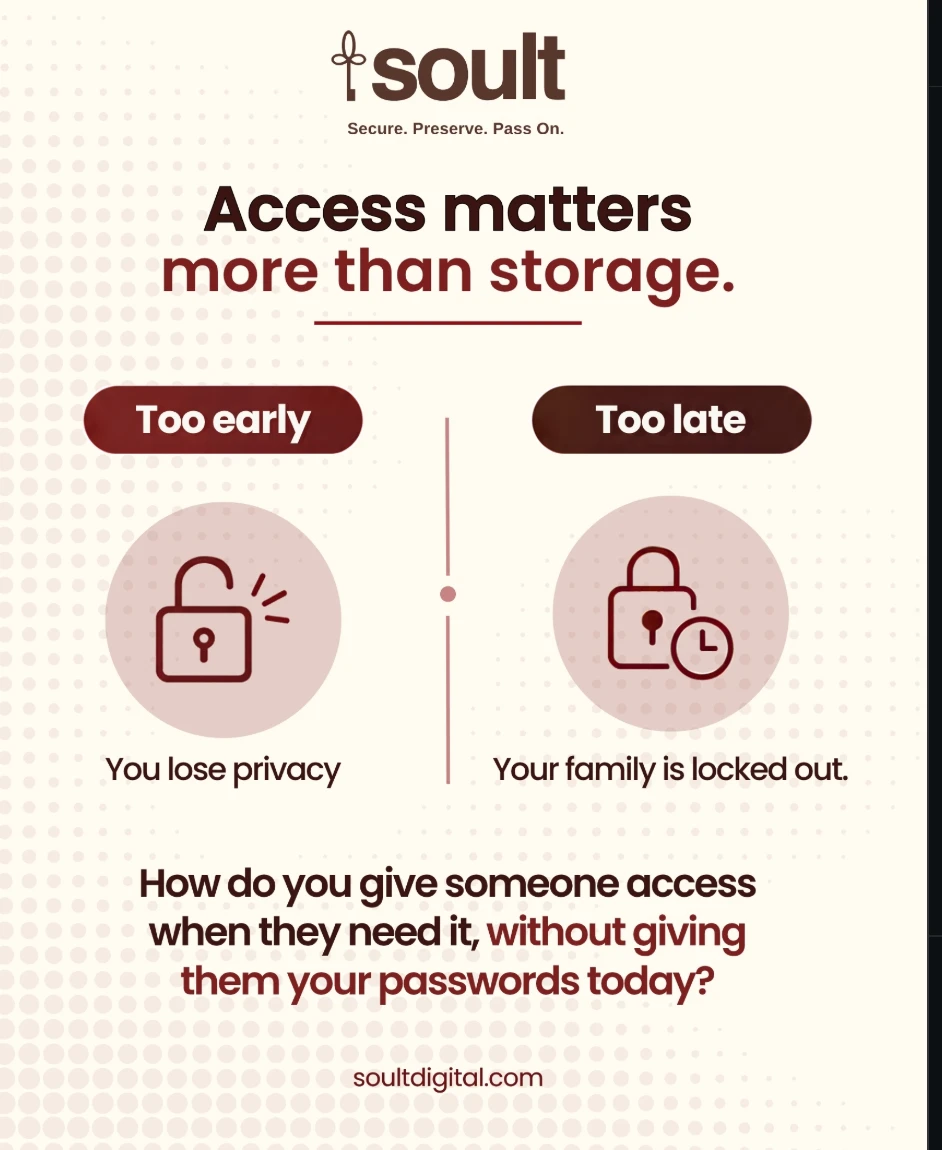
A password-sharing feature is not a complete solution. Neither is automatically releasing everything after a period of inactivity.
Secure handover is not simply granting access. It is honoring the owner's intentions while protecting the people involved.
It requires thoughtful processes for authorization, verification, timing, privacy, and accountability. And importantly, secure handover must distinguish between situations such as death, incapacity, and ordinary account recovery. These are fundamentally different events.
The way a family receives information can be just as important as how that information was protected.
The fifth mistake: Believing encryption eliminates legal responsibility
This is another misconception consumers should understand.
A company may advertise zero-knowledge encryption and claim that it cannot read your vault contents. That may be technically correct.
But does the company collect your email address, identity details, payment information, device identifiers, nominee information, or encrypted cloud backups? Who operates the service? Where is that information processed? What happens when you request deletion? Who is accountable if information is compromised?
Zero-knowledge encryption does not automatically mean zero legal responsibility. Data protection laws such as GDPR and India's data protection framework can still impose obligations depending on the company's activities, jurisdiction, and the personal data it processes. And merely publishing source code does not prove regulatory compliance.
Consumers should expect clear privacy notices, meaningful information about data handling, appropriate security safeguards, and identifiable accountability.
Security is a technical responsibility. Trust is both a technical and an organizational responsibility.
So how should you choose a Digital Life Vault?
Before trusting any provider with your life's information, ask seven questions.
- 1. Everyday usefulness: Does it help me organize and manage my life today, or is it simply a place to upload files?
- 2. Security: How is information protected, who can decrypt it, and are different sensitivity levels handled appropriately?
- 3. Backup: If my phone disappears tomorrow, will my information still exist somewhere independently and securely?
- 4. Recovery: If I forget my credentials, what exactly can be recovered? What might be lost forever?
- 5. Human value: Can I preserve memories, stories, relationships, values, wishes, and instructions — not just financial records?
- 6. Secure handover: How will the right people receive the right information under the right circumstances, including incapacity or death?
- 7. Accountability: Who operates the service, what privacy laws apply, how is data handled, and what happens if the provider itself disappears?
Do not settle for marketing labels. Ask for explanations. Understand the limitations. Look for tested processes and documented safeguards.
You may still choose a local encrypted vault, a password manager, or a zero-knowledge solution. That is perfectly reasonable if it serves your purpose.
But if your purpose is to preserve an entire life for yourself and your loved ones, your evaluation must go far beyond encryption.
The 16-point checklist
Those seven questions are where the conversation starts. If you want to go further, here is the full checklist: 16 things to check before trusting any platform with your life, grouped into four areas.
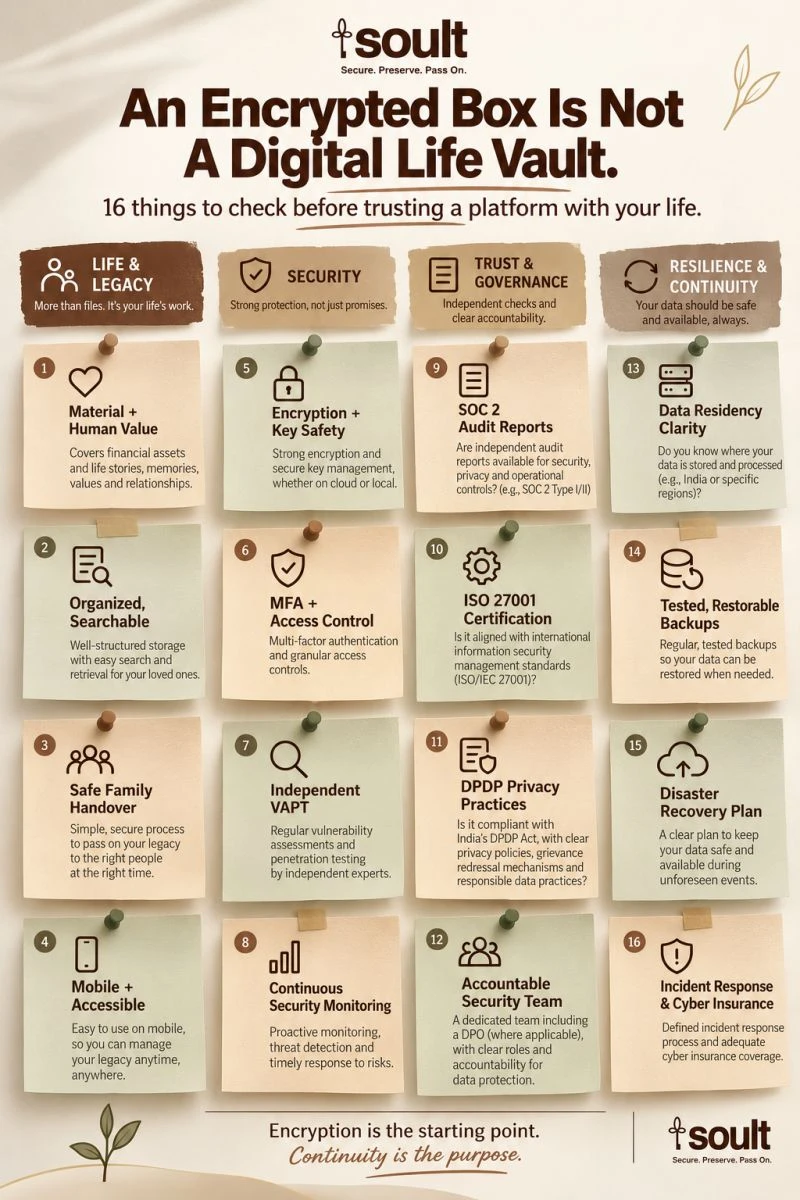
Life & Legacy: more than files, it is your life's work
- 1. Material + Human Value: Does it cover financial assets as well as life stories, memories, values and relationships?
- 2. Organized, Searchable: Is information well structured, with easy search and retrieval for your loved ones?
- 3. Safe Family Handover: Is there a simple, secure process to pass on your legacy to the right people at the right time?
- 4. Mobile + Accessible: Is it easy to use on mobile, so you can manage your legacy anytime, anywhere?
Security: strong protection, not just promises
- 5. Encryption + Key Safety: Is there strong encryption and secure key management, whether on cloud or local?
- 6. MFA + Access Control: Does it offer multi-factor authentication and granular access controls?
- 7. Independent VAPT: Is there regular vulnerability assessment and penetration testing by independent experts?
- 8. Continuous Security Monitoring: Is there proactive monitoring, threat detection and timely response to risks?
Trust & Governance: independent checks and clear accountability
- 9. SOC 2 Audit Reports: Are independent audit reports available for security, privacy and operational controls (for example, SOC 2 Type I/II)?
- 10. ISO 27001 Certification: Is it aligned with international information security management standards (ISO/IEC 27001)?
- 11. DPDP Privacy Practices: Is it compliant with India's DPDP Act, with clear privacy policies, grievance redressal and responsible data practices?
- 12. Accountable Security Team: Is there a dedicated team, including a DPO where applicable, with clear roles and accountability for data protection?
Resilience & Continuity: your data should be safe and available, always
- 13. Data Residency Clarity: Do you know where your data is stored and processed (for example, India or specific regions)?
- 14. Tested, Restorable Backups: Are backups regular and tested, so your data can actually be restored when needed?
- 15. Disaster Recovery Plan: Is there a clear plan to keep your data safe and available during unforeseen events?
- 16. Incident Response & Cyber Insurance: Is there a defined incident response process and adequate cyber insurance coverage?
If a platform cannot give clear answers on most of these, it may be an encrypted box. It is not yet a Digital Life Vault.
Encryption is the starting point. Continuity is the purpose.
This is the problem we set out to solve at Soult
When we began building Soult, we were not trying to create another encrypted storage application. We were asking a much bigger question:
How do we preserve everything meaningful in a person's life and ensure that its value continues, even when that person is no longer around to guide their loved ones?
That thinking shaped our vision for Soult as a comprehensive Digital Life Vault. It is why we believe in organizing life into meaningful compartments, recognizing different sensitivities, protecting both material and human value, and designing for recoverability and continuity.
It is also the thinking behind CHAKRA, our approach to controlled, verified handover.
These are not simply features to add to an encrypted database. They are different parts of a much larger responsibility. We are continuing to develop and strengthen this approach because there is no single technical shortcut to solving the entire problem.
The question worth remembering
Encryption is essential. Privacy is essential. Open-source transparency can be valuable. Cloud backups and password managers have important roles.
But none of these, by itself, defines a Digital Life Vault.
The real test is not simply how well a vault protects information while its owner is present. It is how reliably that information remains useful, meaningful, recoverable, and appropriately accessible when circumstances change.
A vault should help you live with greater clarity today. It should preserve not only what you accumulated, but also what you learned, believed, experienced, and wished to pass on. And when you are no longer around, it should help your loved ones understand what matters, what exists, what needs to be done, and how to move forward.
That is the difference between storing information and preserving a life.
An encrypted box protects its contents. A true Digital Life Vault protects their meaning, their future, and their continuity.
At Soult, that is the standard we are working to establish.
Secure. Preserve. Pass On.
Soult — World's First Secure Digital Life Vault
Ready to secure your family's future?
Start your free Life Vault today. No credit card required.
Start Free