Why Should I Trust Soult? The Difference Between Familiarity and Real Digital Trust
Trust should not be blind. Learn why we ask the harder questions about familiarity vs. real trust, and how Soult is built around security, transparency, and your family's privacy.
Why Should I Trust Soult?
Trust is one of the first questions people ask when they discover Soult. And it should be.
A digital life vault is not a casual app. It is not a place where someone stores random screenshots or temporary files. Soult is built for some of the most personal parts of a person's life: assets, documents, passwords, wishes, health preferences, memories, relationships, and the context a family may need one day.
So when someone asks, "Why should I trust Soult?", we do not see it as doubt. We see it as responsibility.
In fact, before trusting any digital platform, the better question is this: why do we trust anything digital at all?
Familiarity Often Feels Like Trust
Most of us do not trust technology after studying its architecture. We trust it because it is familiar.
We trust apps we have used for years. We trust platforms our friends use. We trust brands we see often. We trust services that come pre-installed on our phones. We trust banks because they are regulated. We trust government platforms because they feel official.
This is not wrong. It is human.
The brain looks for shortcuts. When something is repeated, visible, and widely used, it starts to feel safe. Familiarity creates comfort. Comfort slowly becomes trust.
But familiarity and trust are not the same thing.
A platform can be familiar and still not be built for your specific need. A tool can be secure for one purpose and unsuitable for another. A service can be excellent in its own category but still not solve the deeper problem of family preparedness, controlled access, and long-term continuity.
That is why the real question is not, "Is this a famous platform?" The better question is, "Is this platform built for this exact purpose?"
Purpose Matters More Than Popularity
A bank is built to transact. Its job is to move, record, verify, report, and protect money within a regulated financial system.
A cloud drive is built to store and sync files. Its job is convenience, availability, collaboration, and access across devices.
A government document locker is built to help citizens access official documents in a structured way.
All of these have value. But they are not the same as a digital life vault.
Soult is built for a different purpose.
Soult is designed to help a person preserve important life information and ensure that selected information reaches the right people, at the right time, in the right way.
That difference matters.
Because family preparedness is not only about storing documents. It is about meaning, access, timing, privacy, and continuity.
A document without context may not help a family. A password without the right access process may remain locked forever. An insurance policy that nobody knows about may never be claimed. A wish that was never recorded may become a dispute. A memory that was never preserved may disappear with time.
Soult exists for this gap.
Security Is Not Just Locking Everything Forever
When people hear the word security, they often imagine one big lock. But real security is more nuanced.
Security means private information should remain private.
It also means access should not be lost when the family genuinely needs it.
For Soult, security is not only about preventing access. It is about controlled access. The user decides what is preserved, who should receive it, and under what conditions. That is very different from simply storing everything in a folder and hoping someone finds it one day.
A digital life vault must balance two responsibilities.
First, it must protect the user's privacy while they are alive and active.
Second, it must help the right people receive the right information when the time comes.
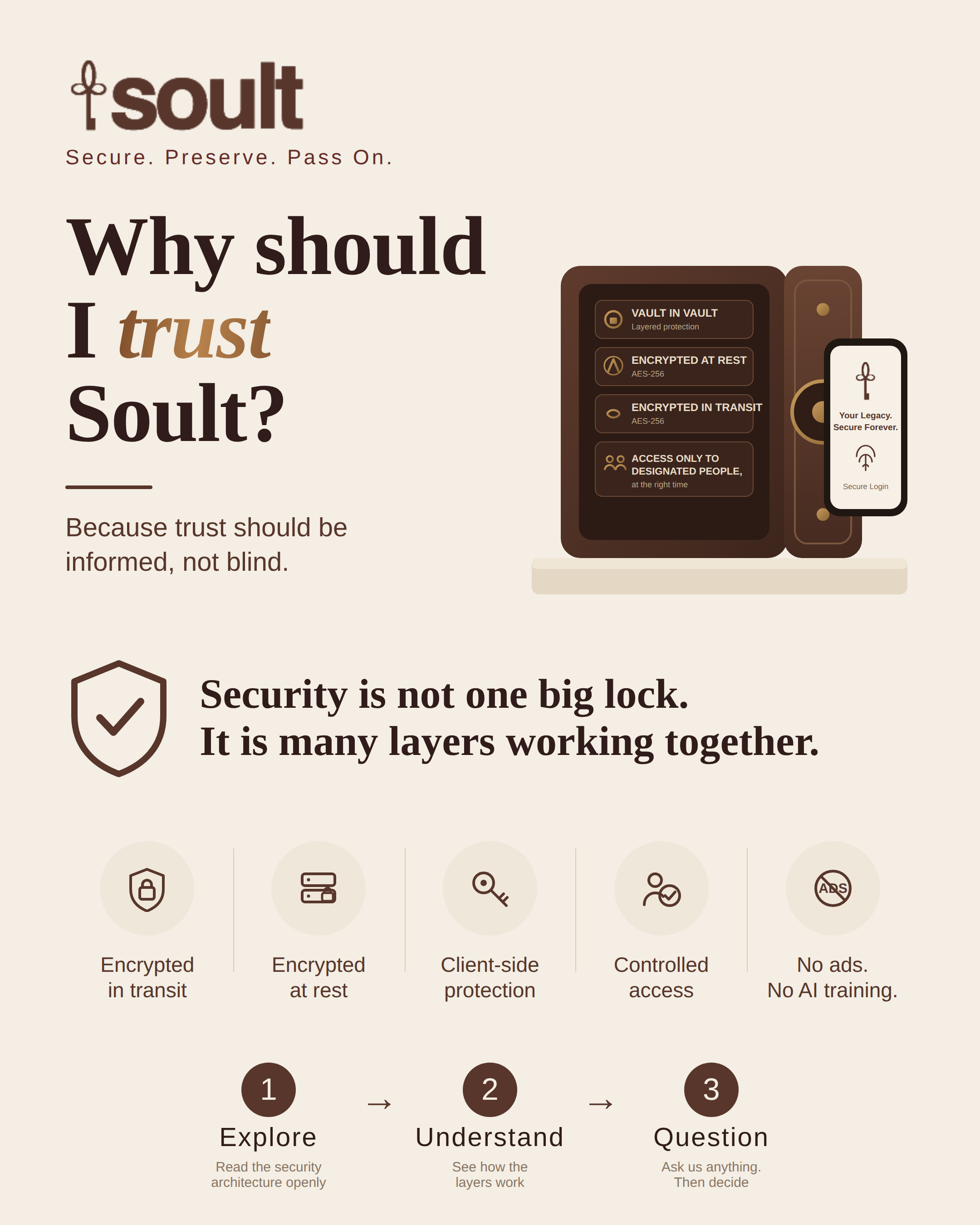
That is why Soult is designed around layers of protection and defined access, not blind storage.
No Honest Company Should Say "We Can Never Be Hacked"
Cybersecurity is not a one-time claim. It is a continuous practice.
No serious company should say, "We can never be hacked." Not even banks say that.
Threats evolve. Attack methods evolve. Technology changes. Responsible companies keep improving their systems, reviewing risks, testing controls, and strengthening their architecture.
At Soult, we believe trust should be built through transparency, not overconfidence.
We do not want users to trust us because we use big technical words. We want users to understand the principles behind our design.
Soult is built with layered security. Data is encrypted in transit. Data is encrypted at rest. Sensitive vault areas have additional protection. Access is controlled. Important actions are logged. The app is designed to avoid casual device caching. We do not monetize user data. We do not show ads. We do not use vault data for AI training.
The purpose is simple: your vault should serve you and your loved ones, not an advertising model.
Familiarity Should Not Replace Understanding
This is where the psychology of trust becomes important.
People often feel safer with familiar tools because they have seen them repeatedly. That comfort is real, but it can also hide gaps.
For example, we may feel that a general storage app is enough because we already know how to upload files. But does it help your family understand which document matters? Does it know who should receive what? Does it separate private information from shareable information? Does it handle memories, wishes, health preferences, nominees, passwords, and loved ones in one structured journey? Does it have a purpose-built access flow for family continuity?
In many cases, the issue is not whether another platform is good or bad. The issue is fitment.
A suitcase is useful. A locker is useful. A bank account is useful. A family vault is useful. But they are not interchangeable.
Soult is not trying to replace every tool people already use. Soult is trying to solve a specific problem: helping individuals and families preserve life's important information in a secure, structured, and meaningful way.
Trust Should Be Informed, Not Blind
We know Soult is a new category for many people. Digital life vaults are not yet as familiar as banking apps, cloud drives, or messaging platforms. That means we have a bigger responsibility to explain, educate, and be transparent.
Trust will not be built in one article. It will be built through architecture, behaviour, communication, support, audits, user education, and consistency over time.
That is why we have published our security architecture openly. We want users, families, advisors, and security-conscious people to explore it, question it, and understand it.
Because blind trust is fragile.
Informed trust is stronger.
Why Soult Takes This Responsibility Seriously
Soult is not just protecting data. Soult is protecting clarity.
Clarity for a spouse who may not know where important financial information is stored. Clarity for children who may not understand their parent's decisions. Clarity for loved ones who may need health preferences, asset details, insurance information, passwords, or personal wishes at a difficult time.
Families do not suffer only because documents are missing. They suffer because context is missing.
Soult is built to preserve that context.
That is why our approach to trust is simple: be honest about risk, be clear about architecture, keep improving security, respect user privacy, and never build a business model that depends on exploiting personal vault data.
So, Why Should You Trust Soult?
Do not trust Soult blindly.
Trust Soult after you understand what we are building, why we are building it, and how seriously we take the responsibility of protecting something as personal as a digital life vault.
Trust Soult because the purpose is clear.
Trust Soult because privacy is central to the design.
Trust Soult because access is controlled by the user.
Trust Soult because security is treated as a continuous practice, not a marketing claim.
Trust Soult because we do not monetize your vault, show ads, or use your vault data for AI training.
Most importantly, trust Soult because we are willing to be questioned.
That is the kind of trust we want to build.
Explore our security architecture
Ready to secure your family's future?
Start your free Life Vault today. No credit card required.
Start Free