Family Preparedness Isn’t a Document. It’s a System.
You’ve added nominees, filed the papers, signed the will. But preparedness isn’t about storing documents — it’s about whether your family could continue with clarity if you weren’t there to explain everything.
Most of us believe we are prepared. We've added nominees, locked away property papers, and signed our wills. On the surface, everything looks organized.
But preparedness isn't about having documents. It's about whether the people we love could continue with clarity if we were no longer there to explain everything.
If something unexpected happened today:
- Would your spouse know where all your investments are?
- Would your children know which insurance policies are active?
- Would they understand why you made certain financial decisions?
Most families don't struggle because information is missing. They struggle because it's fragmented across bank lockers, cloud drives, hospital portals, and notebooks.
But this fragmentation isn't our fault.
For generations, there was no true family preparedness system. We used the tools we had: diaries, physical files, and eventually cloud drives. But a diary can't securely guide the right person at the right time. A bank locker can protect documents, but it can't explain what they mean. A nominee might be named, but the family still might not know the full extent of the assets and responsibilities left behind.
This isn't about blaming ourselves for being unprepared. It's recognizing that we were never given a complete system to begin with.
Storage protects information. A preparedness system protects families.
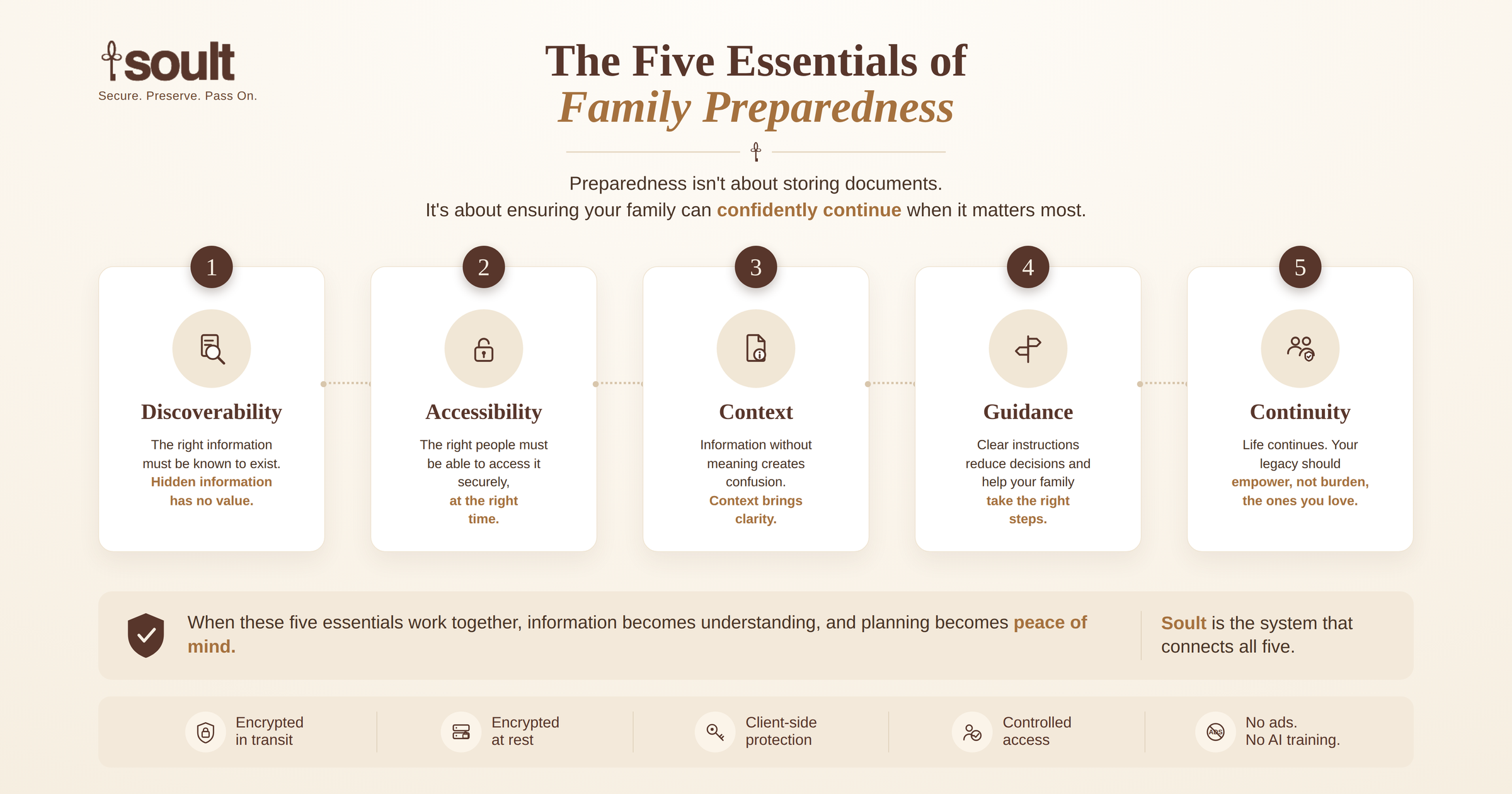
The 5 Pillars of a Preparedness System
A system isn't just a collection of parts; it's parts designed to work together. To truly work, it must provide:
- Discoverability: A clear map of what exists. Families can't act on information they don't know about.
- Accessibility: Secure access for the right people at the right time, balancing privacy with continuity.
- Context: Explaining the why, not just the what. Context turns information into understanding.
- Guidance: Clear direction on what happens first, who to contact, and what is urgent when emotions are high.
- Continuity: Ensuring businesses run, bills are paid, and memories, values, and traditions live on.
Five families, five quiet lessons
These aren't dramatic stories. They're the ordinary ways prepared, loving families still get caught off guard — one for each pillar.
1. Discoverability: "We didn't even know it existed."
Ramesh, a 54-year-old software engineer in Bengaluru, passed away unexpectedly. His wife knew about their home loan and a couple of active bank accounts. That was the extent of their financial conversations over the years.
Six months later, while filing his income tax return, the family received a notice about dividend income from a demat account they had never heard of. After months of scouring old emails, contacting brokers, and navigating endless formalities, they made a discovery: Ramesh had diligently accumulated nearly ₹18 lakh in mutual funds and shares over fifteen years.
He had been building a safety net for them. The money wasn't lost. It simply wasn't discoverable.
The lesson: Wealth has no value if your family doesn't know it exists.
2. Accessibility: "We knew where it was. We still couldn't use it."
Meena always knew her husband was meticulous. He kept every important document in an encrypted folder on his laptop.
After he passed away, she found the laptop exactly where he said it would be. She found the folder. She even found the backup hard drive. But nobody knew the master password.
Their son tried every combination he could think of. Nothing worked. The insurance policies, the investment records, the business documents — all sitting right there, completely inaccessible. The family had to reconstruct his entire financial life from scratch, over several exhausting months. He had done everything right to protect his family, except give them the key.
The lesson: Security should protect your information from strangers — not permanently lock out your loved ones.
3. Context: "We knew the decision, but not the reason."
After their father's death, two brothers and a sister gathered to distribute the family assets. The registered will was clear: the ancestral home would go entirely to their sister. Nobody understood why. The brothers felt deeply hurt, and arguments quickly fractured the family.
Months later, while cleaning out an old cupboard, they found a handwritten letter. In it, their father explained that their sister had spent ten years quietly caring for both parents after their retirement, while the brothers had settled abroad.
He wasn't playing favourites. He was expressing gratitude. Had that simple explanation been available alongside the will, years of resentment could have been avoided.
The lesson: Documents record decisions. Context preserves relationships.
4. Guidance: "We had the information, but nobody knew what to do first."
Amit was admitted to the ICU after a major accident. He survived, but remained unconscious for several critical weeks. Overnight, his wife found herself managing everything alone.
She knew there were health insurance policies. She knew there were investments. She knew he handled all the finances. What she didn't know was where to begin. Should she inform his employer first? Which policy covered the hospital billing? Which EMI was due next week? Who was their financial advisor?
Every decision felt urgent, but nothing came with instructions. Everything was eventually sorted — but only after weeks of terrifying uncertainty.
The lesson: In a crisis, families don't just need a folder of documents. They need a roadmap.
5. Continuity: "The business survived. Its soul almost didn't."
Mahesh ran a successful, family-owned manufacturing business in Coimbatore. When he passed away, his children stepped in to take over. Because the records and legal documents were well maintained, the company kept running. But something vital disappeared.
Every major supplier relationship existed because of Mahesh's personal trust. He remembered people's birthdays. He quietly approved small scholarships for his employees' children. He never squeezed his small vendors on margins. None of it was written down.
The business survived financially, but its culture almost vanished overnight. Over the next few years, his children had to painfully rebuild those relationships from scratch — constantly wishing they knew how their father made his decisions.
The lesson: Continuity is about more than passing on assets. It's about preserving judgment, values, and wisdom.
Why We Built Soult
While designing Soult, we realized the world didn't have a storage problem. It had a continuity problem.
We built Soult as a Digital Life Vault — not simply to store files, but to create a connected system where assets, records, health preferences, memories, and loved ones come together with the context and guidance families actually need.
Preparedness isn't measured by how much information we leave behind. It is measured by how little confusion we leave behind.
The question isn't, "Where are my documents?"
The better question is, "If I were not here to explain them, would my family know what to do next?"
Ready to secure your family's future?
Start your free Life Vault today. No credit card required.
Start Free